
What Exactly is a “Wrongful Death” Claim in Georgia? A Plain English Guide
Losing a loved one is undeniably one of life’s most painful experiences. The grief is often compounded when that loss is sudden, unexpected, and—worst of all—the result of someone else’s carelessness or intentional wrongdoing. In such tragic circumstances, families in Georgia may find themselves grappling with a legal term: “wrongful death.” This phrase often brings more questions than answers during an already impossible time. What does it mean? How is it different from other claims? Can it truly bring justice?
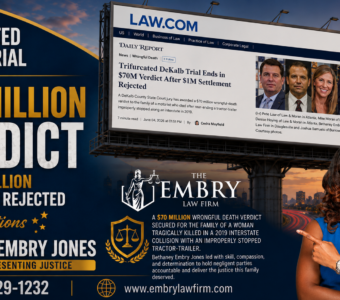
At The Embry Law Firm, we understand that no legal action can ever truly replace a loved one. However, a wrongful death claim can provide essential financial stability and a sense of accountability for families left behind. Our compassionate and experienced team, led by Bethaney Embry Jones, has helped over 4,000 families recover more than $40 million in personal injury, car accident, and workers’ compensation cases. We are dedicated to guiding you through this complex process with clarity and empathy.
Bethaney Embry Jones and her team are some of Georgia’s Most Experienced Personal Injury, Car Accident, Car Crash and Workers’ Compensation Lawyers. $40+ Million Recovered. 4000+ Families Helped.
Defining Wrongful Death Under Georgia Law
In Georgia, a “wrongful death” claim is a type of civil lawsuit brought when a person dies due to the negligence, carelessness, recklessness, or intentional act of another party. It’s essentially a claim that the deceased person would have had if they had survived their injury. The purpose of this claim is to compensate the surviving family members for the full value of the deceased’s life.
Georgia law (specifically O.C.G.A. § 51-4-1 and O.C.G.A. § 51-4-2) recognizes two distinct types of claims that arise from a death caused by another’s wrongdoing:
- The Wrongful Death Claim (or “Full Value of the Life” Claim): This is the claim brought by certain surviving family members (usually the spouse, children, or parents) to recover for the intangible value of the deceased’s life. This includes both the economic and non-economic value.
- The Estate Claim (or “Survival Action”): This claim is brought by the executor or administrator of the deceased person’s estate to recover for specific economic losses and suffering experienced by the deceased between the time of injury and death.
Understanding the difference between these two claims is critical, as they cover different types of damages and are brought by different parties.
Who Can File a Wrongful Death Claim in Georgia?
Georgia law is specific about who has the legal standing to file a wrongful death claim. The order of priority is as follows:
- Spouse: If the deceased person was married, the surviving spouse has the first right to bring the claim. If there are also surviving children, the spouse must share the recovery with them, with the spouse receiving at least one-third of the total.
- Children: If there is no surviving spouse, the children of the deceased person can bring the claim.
- Parents: If there is no surviving spouse or children, the parents of the deceased person can bring the claim.
- Administrator of the Estate: If there is no surviving spouse, children, or parents, the administrator of the deceased person’s estate can bring the claim on behalf of the next of kin.
This hierarchy ensures that the closest family members are prioritized in seeking justice and compensation.
What Damages Can Be Recovered in a Wrongful Death Claim?
The “full value of the life” is a comprehensive measure of damages in a Georgia wrongful death claim. This includes both economic and non-economic factors:
- Economic Value: This covers all financial contributions the deceased person would have made had they lived. This includes:
- Their lifetime earnings and future earning capacity.
- Benefits and services they would have provided (e.g., childcare, household management, mentorship, financial advice).
- Non-Economic Value: This is much harder to quantify but is incredibly significant. It represents the intangible aspects of the deceased’s life, such as:
- The loss of companionship, care, counsel, and guidance.
- The emotional distress and suffering experienced by the surviving family members due to the loss.
- The joy, comfort, and affection the deceased would have provided.
It’s important to note that Georgia law does not allow surviving family members to claim their own grief and suffering in the wrongful death claim itself. The “full value of the life” focuses on the value of the deceased’s life to themselves and to their family.
What Damages Can Be Recovered in an Estate Claim (Survival Action)?
The estate claim (also known as a survival action) is separate from the wrongful death claim and compensates for different types of losses. It is typically brought by the executor or administrator of the deceased’s estate and can recover for:
- Medical Expenses: Any medical bills incurred by the deceased from the time of the injury until their death.
- Funeral and Burial Expenses: The costs associated with the funeral and burial of the deceased.
- Pain and Suffering of the Deceased: The physical pain and mental anguish the deceased person experienced between the time of injury and death.
- Property Damage: If the incident involved property damage (e.g., a car accident), the cost of repairs or replacement for that property.
Any funds recovered through an estate claim become part of the deceased person’s estate and are distributed according to their will or Georgia’s laws of intestacy.
Common Causes of Wrongful Death
Wrongful death claims can arise from a wide range of negligent or intentional acts. Some common causes include:
- Car Accidents: By far one of the most frequent causes, often due to distracted driving, drunk driving, speeding, or reckless behavior.
- Truck Accidents: Collisions involving large commercial trucks often result in severe injuries and fatalities due to their sheer size and weight.
- Motorcycle Accidents: Motorcyclists are highly vulnerable, and even minor negligence from other drivers can lead to tragic outcomes.
- Medical Malpractice: Deaths resulting from medical errors, misdiagnosis, surgical mistakes, or nursing home negligence.
- Defective Products: Fatalities caused by faulty products, from automotive parts to dangerous consumer goods.
- Premises Liability: Deaths occurring due to unsafe conditions on someone else’s property, such as slip and falls, negligent security, or drowning incidents.
- Workplace Accidents: Fatalities occurring on the job due to unsafe conditions, equipment failure, or employer negligence.
In each of these scenarios, the key is proving that another party’s actions directly led to the death.
The Statute of Limitations in Georgia
It is crucial to understand that there are strict deadlines for filing a wrongful death claim in Georgia, known as the statute of limitations. Generally, a wrongful death claim must be filed within two years from the date of the person’s death. There are very few exceptions to this rule, and missing this deadline almost certainly means losing your right to pursue a claim. Because of the complexity and the emotional toll, it is vital to contact an attorney as soon as possible after a tragic loss.
Conclusion
Losing a loved one is an unimaginable tragedy, and the added burden of understanding complex legal terms like “wrongful death” can feel overwhelming. However, a wrongful death claim in Georgia is a critical legal tool designed to provide surviving families with both financial security and a measure of justice and accountability. It acknowledges the profound loss of companionship, guidance, and financial support that a family endures.
At The Embry Law Firm, Bethaney Embry Jones and her team approach every wrongful death case with immense compassion, sensitivity, and fierce dedication. With over $40 million recovered and 4000+ families helped, we have the experience and resources to meticulously investigate the circumstances of your loved one’s death, identify all responsible parties, and fight tirelessly for the maximum compensation you deserve. While no amount of money can ever bring back your loved one, we can help secure your family’s financial future and hold negligent parties accountable. If you believe your loved one’s death was caused by someone else’s wrongdoing, please contact us for a compassionate and confidential consultation.